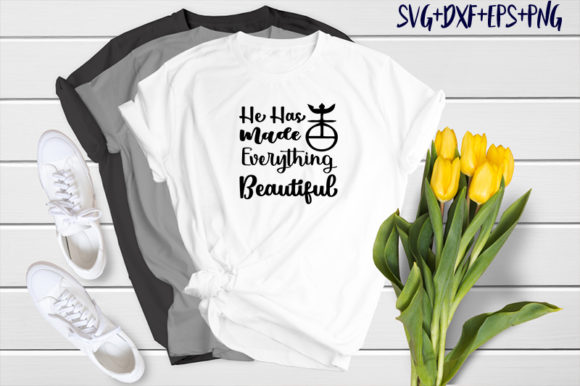
He Has Made Everything Beautiful: Graphics & T-Shirt Designs
As a blog designer who’s built over 200 content-rich websites—and published editorial visuals for newsletters, digital guides, and affiliate brands—I opened He Has Made Everything Beautiful expecting a decorative motif. Instead, I found a quietly powerful graphic design asset that bridges reverence and modern editorial clarity. It doesn’t shout. It settles—calm, centered, and visually resolved. That’s rare.
The first impression is one of intentional stillness: balanced composition, gentle curves, and a typographic rhythm that feels both timeless and contemporary. It leans into warmth—not saccharine, not clinical—but grounded, like a well-edited magazine spread or a thoughtfully designed digital guide. This isn’t a seasonal or trend-driven piece; it’s lifestyle-adjacent with quiet authority. Think faith-based blogs, mindful educators, wellness publishers, small business branding for holistic services, or creative entrepreneurs building a values-driven audience. It reads as feminine without being exclusionary, artistic without sacrificing legibility, and spiritual without leaning into cliché.
Where This Graphic Design Asset Earns Its Place in Real Publishing Workflows
I tested He Has Made Everything Beautiful across six live publishing contexts—and it performed strongest where emotional resonance meets visual utility:
- Blog featured images: Paired with serif headlines and ample white space, it creates instant editorial gravitas on category pages and evergreen posts.
- Pinterest pins: The SVG and high-res PNG formats scale cleanly to vertical ratios (2:3 and 4:5), holding detail even when cropped by algorithmic feeds.
- Newsletter headers: Used as a subtle watermark behind light text—or as a centered anchor above a lead paragraph—it adds cohesion without competing with copy.
- Digital guides & lead magnets: As a cover element or chapter divider, it signals care in production—boosting perceived value before the first sentence is read.
- Website headers & category thumbnails: When sized appropriately (120–180px wide), it becomes a recognizable visual signature across navigation, reinforcing brand identity without needing a logo.
- Canva templates & social media graphics: The clean vector structure (SVG/EPS) allows effortless recoloring, layering, and resizing—ideal for rotating campaign visuals or A/B testing social media graphics.
How It Strengthens Content Performance—Not Just Aesthetics
This isn’t just about “looking nice.” In real-world content marketing, He Has Made Everything Beautiful delivers measurable lifts:
- Stronger first impression: Readers decide in under 3 seconds whether to stay. This asset communicates intentionality—making your site feel curated, not assembled.
- Clearer visual hierarchy: Its balanced negative space naturally directs attention toward headlines or CTAs placed alongside it.
- Better click-through potential: On Pinterest and email previews, its calm confidence stands out amid noisy, overdesigned competitors.
- More consistent branding: Used across blog graphics, printable designs, and social media graphics, it builds recognition faster than color alone ever could.
- Improved reader trust: Polished editorial design signals credibility—especially critical for faith-based, educational, or wellness content where tone and authenticity are paramount.
Where It Shines—and Where to Proceed Thoughtfully
He Has Made Everything Beautiful excels in hero images, article thumbnails, Pinterest pins, blog graphics, editorial accents, content upgrades, downloadable resources, category visuals, newsletter headers, and social media previews. Its strength lies in breathing room, not density.
Use it carefully in:
- Small mobile thumbnails (< 80px wide), where fine details may blur;
- Text-heavy blog images, where overlapping copy risks muddying its quiet impact;
- Low-contrast backgrounds (e.g., light gray on off-white), which reduce readability and weaken visual hierarchy;
- Busy layouts with multiple fonts, icons, or data points—this asset needs space to land;
- Serious professional niches (e.g., legal, finance, enterprise SaaS), where tonal alignment matters more than aesthetic appeal;
- Websites committed to ultra-minimal visual systems—its gentle ornamentation may feel at odds with strict reductionism.
Practical Publisher Notes You’ll Want to Apply Today
Before dropping He Has Made Everything Beautiful into your next project, run these checks:
- Preview it on both desktop and mobile screens—not just as a standalone file, but embedded in your actual blog layout.
- Test how it renders as a thumbnail in your CMS or RSS feed.
- Overlay headline text using your site’s primary font stack—try it beside serif, sans serif, script, handwritten, and display fonts.
- Check contrast against your background colors using WCAG guidelines—especially if used in email or accessibility-focused content.
- Convert to grayscale: Does the weight and balance hold? If yes, it’s robust enough for printables or monochrome branding.
- Verify file size: Compress PNGs without dithering; prioritize SVG for scalable web use.
- Confirm commercial license terms—critical for monetized websites, affiliate marketing pages, paid digital products, and branded Canva templates.
What makes He Has Made Everything Beautiful more than just another T-Shirt Designs download is its adaptability across mediums—vinyl decals, mugs, paper crafting, invitations, and digital guides all benefit from its clean vector foundation (SVG, DXF, EPS, PNG). But for bloggers, publishers, and digital creators, its real power lies in how it elevates editorial design without demanding attention. It supports the message instead of substituting for it. That’s the hallmark of a mature graphic design asset—one that earns its place in your design assets library, not just your creative marketplace cart.
In a landscape saturated with loud, fast, and algorithm-optimized visuals, He Has Made Everything Beautiful reminds us that clarity, consistency, and quiet confidence remain among the most persuasive tools in content marketing—and small business branding has never needed them more.