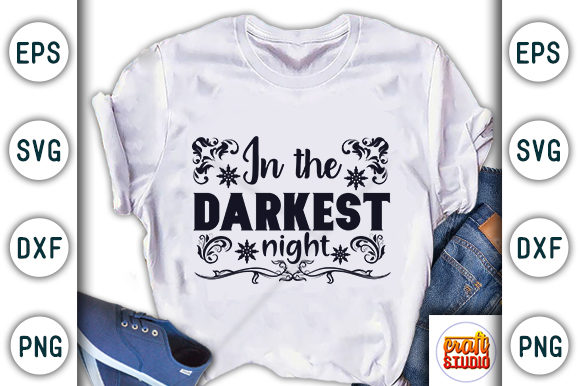
In the Darkest Night
As someone who’s stitched hundreds of designs across apparel, home goods, and boutique gifts—everything from delicate baby onesies to rugged tote bags—I opened In the Darkest Night expecting mood, not just motif. What I found wasn’t just a graphic; it was a quiet, confident statement—one that leans into contrast, simplicity, and emotional resonance. It’s the kind of design that feels intentional in its restraint: clean lines, balanced negative space, and a visual weight that lands without shouting.
I tested In the Darkest Night first on a heavyweight organic cotton sweatshirt for a small-batch holiday collection—intended as a limited-run embroidered gift for local bookstore patrons. The theme fits naturally there: thoughtful, literary, quietly evocative. But more importantly, the layout held up beautifully when digitized for machine embroidery. No overcrowded corners. No micro-details begging to vanish under thread. Just strong silhouette work and breathing room—exactly what you need when translating digital graphics into stitched texture.
This isn’t a design built for dense fill stitches or flashy satin borders. It leans into subtlety: think running stitch outlines, open negative space, and shapes defined by contour rather than density. That makes it unusually versatile across real-world embroidery projects—especially where fabric texture or wear matters. On a linen tea towel? It reads clearly at 3.5 inches wide. On a curved cap front? It scales down cleanly without losing legibility. On a soft baby onesie? It stays gentle—no bulky underlay or aggressive stitch stacking to irritate sensitive skin.
That said, In the Darkest Night isn’t magic—it’s a tool. And like any tool, its success depends on how you wield it. For example, avoid placing it near seams or hems on stretchy fabrics unless you’ve tested stabilizer pairing first. Its clean lines can blur if the base fabric shifts mid-stitch, especially on lightweight knits. On dark fabric, make sure your thread color lifts the design—not drowns it. A charcoal gray thread on black fleece may disappear entirely, while matte black thread on navy twill adds quiet sophistication. Always test on scrap fabric first, especially if you’re planning commercial embroidery runs or Etsy listings where consistency matters.
Where In the Darkest Night truly shines is in handmade product storytelling. Think: a minimalist embroidered pillow cover for a nursery with moon-and-star motifs, or a custom apron for a coffee roaster whose brand voice leans poetic and grounded. It doesn’t scream “holiday” or “baby” outright—but it *feels* right for those contexts because it’s emotionally anchored, not seasonally boxed. That gives craft business owners room to position it thoughtfully—no forced themes, no over-explaining needed.
I also ran it through several printable mockups—black tee, oatmeal tote, indigo denim jacket—and noticed something subtle but important: In the Darkest Night gains presence in monochrome settings. It doesn’t rely on color gradients or layered effects. That means your digital embroidery file translates cleanly whether you’re previewing on an Etsy listing or prepping for a client presentation. No surprises when the final stitched version arrives—it looks like the mockup, just warmer, more tactile, more *made*.
For Etsy sellers and small shop owners, this is gold. Customers respond to authenticity, not clutter. A design like In the Darkest Night supports that instinct. It pairs well with neutral palettes, natural fibers, and slow-made branding. It won’t compete with busy patterns on a patchwork quilt or overwhelm a delicate silk scarf—but it will hold its own on a hand-dyed canvas tote or a wool-blend blanket edge. And because it’s offered as both vector (EPS, SVG) and raster (PNG, DXF), you can adapt it across mediums: vinyl decals for mugs, cut files for leather patches, or cleaned-up versions for applique designs.
Still, don’t skip the practical checks before launching it into production. Confirm your hoop size accommodates the widest version you plan to use—some layouts expand gracefully, others hit hard limits at 4 inches. Review stitch density: low-density areas should stay crisp on textured fabrics like terry cloth or bouclé, while tighter sections must avoid pucker on thin cotton poplin. Inspect corners and curves closely—if the original graphic has fine tapering ends or narrow joins, they may need manual cleanup before digitizing for embroidery. And yes—always verify licensing terms. Since In the Darkest Night is listed under T-Shirt Designs and Graphics, and marketed for use on clothes, scrapbooking, and cut machines, assume commercial use is permitted *only* for finished physical products—not resale of the digital embroidery file itself—unless stated otherwise by the creator.
One last note: this design earns trust because it doesn’t try to do everything. It doesn’t cram in stars, moons, bats, and quotes. It settles into one idea and owns it. That clarity carries through to the finished product—whether it’s a personalized gift for a grieving friend (where quiet symbolism resonates deeply), a boutique-branded kitchen towel set, or a custom embroidered patch for a poetry collective’s merch line. People notice craftsmanship, not just content. When a design breathes, the stitching does too.
If you're evaluating In the Darkest Night for your next embroidery project, ask yourself: Does it match the tone of the item I’m making? Will it age well visually after five washes? Does it feel like part of my brand—not just an add-on? If the answer is yes to two of those, you’re already ahead. This isn’t background noise. It’s a considered voice—soft, steady, and ready to be stitched with intention.
- Test In the Darkest Night on scrap fabric matching your final project’s weight and stretch
- Check thread color contrast on both light and dark fabric backgrounds
- Review stitch density—especially around fine lines and open areas
- Confirm hoop size compatibility before digitizing for machine embroidery design use
- Inspect small details in the original SVG or EPS file before converting to embroidery file format
- Use appropriate stabilizer for fabric texture—cutaway for knits, tear-away for stable wovens
- Verify licensing before selling finished embroidered items commercially or listing digital embroidery files
- Consider how In the Darkest Night supports your handmade product story—not just its visual fit