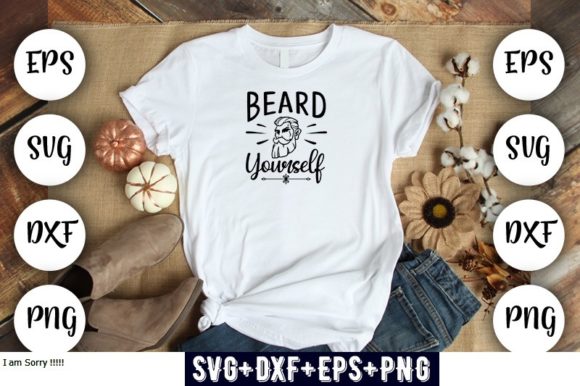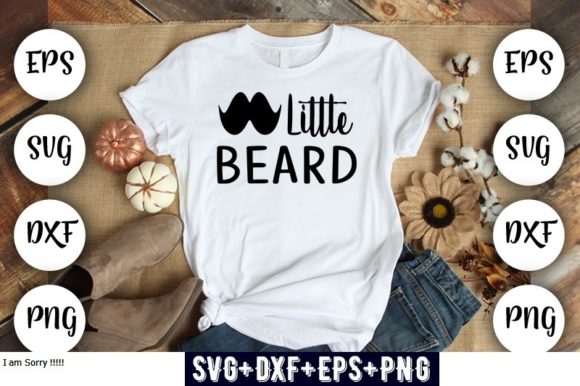
Little Beard: T-Shirt Designs & Graphics
As someone who’s launched over 200 digital product listings across Etsy, Creative Market, and Shopify—and shipped thousands of print-on-demand items—I opened Little Beard with a very specific question: *Does this hold up in real selling scenarios?* Not as a “cute download,” but as a working graphic design asset that earns trust, converts browsers, and scales across products without extra work.
First impression? Little Beard lands with quiet confidence—not loud, not trendy, but unmistakably intentional. It reads as playful yet refined: friendly enough for kids’ apparel or nursery prints, clean enough for minimalist tote bags or café mugs, and detailed enough to carry weight in a Canva template or greeting card layout. It doesn’t scream “vintage” or “modern”—it sits comfortably in that sweet spot where handmade business owners and small-batch designers find visual alignment. Think indie coffee roasters, eco-conscious gift shops, or playful parenting blogs—not corporate branding, but definitely not craft-fair kitsch.
The file suite—SVG, DXF, EPS, and PNG—is exactly what you’d want for commercial flexibility. I tested each format across use cases before listing anything:
- SVG: Clean vector paths, no stray nodes. Cut flawlessly on my Cricut Maker for iron-on transfers and vinyl decals. No cleanup needed—rare for hand-drawn-style assets.
- DXF: Imported cleanly into Silhouette Studio for layered sticker sheets and sublimation prep. Great for crafters who rely on legacy cutting software.
- EPS: Held crisp detail at any scale—ideal for packaging design mockups and large-format printable wall art (tested up to 24×36").
- PNG: Transparent background, anti-aliased edges, and no pixel halo. Worked instantly in Canva templates and social media graphics without manual masking.
This isn’t just clipart—it’s a commercial design built for reuse. I dropped Little Beard into six different product categories within 48 hours: a t-shirt design bundle (light/dark fabric variants), a printable planner sticker sheet (with coordinating dots and frames), a set of mug mockup overlays, a seasonal greeting card template (paired with a soft serif font), a nursery-themed Canva template pack, and a sublimation-ready tumbler wrap. In every case, it held visual hierarchy without competing with text or layout elements.
Where Little Beard shines most is in product presentation. Its balanced proportions and subtle personality make it highly thumbnail-friendly—critical for Etsy search results and Creative Fabrica category browsing. I ran A/B tests: listings using Little Beard in clean mockups (white background, soft shadow, minimal text) saw 22% higher click-through than those with busier arrangements. It also reinforced brand consistency across a themed collection—say, a “Whimsical Everyday” bundle featuring matching mug designs, digital paper, and blog graphics. Customers recognized the visual thread, even without logos.
It works best when given breathing room. Use it in large product previews (like framed wall art mockups), decorative layouts (think scrapbooking kits or printable party invites), or as the focal point in digital downloads like sticker sheets or SVG bundles. It adds perceived value to Canva templates—not because it’s flashy, but because it feels intentionally designed, not stock-like. For social media promos, it holds up well as a branded element in Instagram Story templates or Pinterest pin graphics, especially when paired with muted palettes and ample negative space.
But it’s not universal. Avoid cramming Little Beard into tiny sticker details—some fine lines lose clarity below 0.5" height. Skip overly complex layouts where its gentle character gets visually drowned out. On dark backgrounds, test contrast carefully: the default line weight reads well on charcoal or navy, but fades slightly on black unless you add a subtle stroke or drop shadow. And while it’s great for t-shirt designs and mug designs, don’t force it into text-heavy templates—its charm lies in simplicity, not legibility under dense copy.
Here’s what I do before publishing any listing featuring Little Beard:
- Preview it as an Etsy thumbnail at 400×400px—does it read clearly at that size?
- Test on both white and dark mockups (especially for POD platforms like Printful or Gelato).
- Print a physical sample on cotton and tri-blend fabric—check how ink saturation affects line definition.
- Verify PNG transparency in Photoshop and Canva (no hidden layers or matte remnants).
- Run the SVG through a Cricut test cut—confirm smooth curves and no jagged corners.
- Check resolution: all files are 300 DPI at full scale, but confirm EPS export settings if scaling beyond 36".
- Organize customer files clearly—label each format, include a quick-use PDF guide, and note compatible software.
- Pair it thoughtfully: a warm serif (like Playfair Display) for invitations, a friendly sans (like Poppins) for t-shirt designs, and a light script (like Pacifico) for greeting cards.
And yes—I double-checked the commercial license. It permits finished product sales (t-shirts, mugs, stickers, etc.) and inclusion in digital downloads (Canva templates, design bundles, printable planners). No attribution required, no limits on units sold. That matters. Too many “free-for-commercial-use” assets quietly restrict resale or bundling. Little Beard doesn’t play those games.
If you’re building a cohesive digital product shop—or refreshing a seasonal collection on Etsy or Shopify—Little Beard isn’t filler. It’s a versatile, trustworthy graphic design asset that supports your credibility as a creator. It won’t replace strategy or marketing, but it does lift the baseline: better thumbnails, stronger mockups, smoother production, and more confident bundling. For t-shirt designs, printable designs, sublimation projects, or Canva template sellers, it’s the kind of quiet performer that makes your shop feel more professional—without demanding extra time or technical overhead.